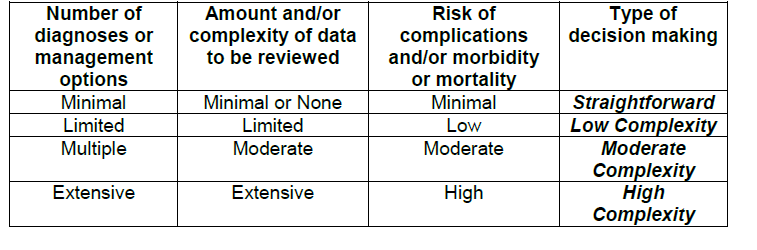
Risk of Significant Complications, Morbidity, and/or Mortality
The risk of significant complications, morbidity, and/or mortality is based on the risks associated with the following categories:
** Presenting problem(s);
** Diagnostic procedure(s); and
** Possible management options.
The assessment of risk of the presenting problem(s) is based on the risk related to the disease process anticipated between the present encounter and the next encounter.
The assessment of risk of selecting diagnostic procedures and management options is based on the risk during and immediately following any procedures or treatment. The highest level of risk in any one category determines the overall risk. The level of risk of significant complications, morbidity, and/or mortality can be:
** Minimal;
** Low;
** Moderate; or
** High.
Some important points that should be kept in mind when documenting level of risk are:
** Comorbidities/underlying diseases or other factors that increase the complexity of medical decision making by increasing the risk of complications, morbidity, and/or mortality should be documented;
** If a surgical or invasive diagnostic procedure is ordered, planned, or scheduled at the time of the E/M encounter, the type of procedure should be documented;
** If a surgical or invasive diagnostic procedure is performed at the time of the E/M encounter, the specific procedure should be documented; and
** The referral for or decision to perform a surgical or invasive diagnostic procedure on an urgent basis should be documented or implied.
'
The table on the next page may be used to assist in determining whether the level of risk of significant complications, morbidity, and/or mortality is minimal, low, moderate, or high. Because determination of risk is complex and not readily quantifiable, the table includes common clinical examples rather than absolute measures of risk.