Showing posts with label document. Show all posts

Wednesday, September 14, 2016

Medical record - Documentation of History - How to

A. DOCUMENTATION OF HISTORY

The levels of E/M services are based on four types of history (Problem Focused, Expanded Problem Focused, Detailed, and Comprehensive). Each type of history includes some or all of the following elements:

Chief complaint (CC);

History of present illness (HPI);

Review of systems (ROS); and

Past, family and/or social history (PFSH).


The extent of history of present illness, review of systems, and past, family and/or social history that is obtained and documented is dependent upon clinical judgment and the nature of the presenting problem(s).

The chart below shows the progression of the elements required for each type of history. To qualify for a given type of history, all three elements in the table must be met. (A chief complaint is indicated at all levels.)


*DG: The CC, ROS and PFSH may be listed as separate elements of history, or they may be included in the description of the history of the present illness.

*DG: A ROS and/or a PFSH obtained during an earlier encounter does not need to be re-recorded if there is evidence that the physician reviewed and updated the previous information. This may occur when a physician updates his/her own record or in an institutional setting or group practice where many physicians use a common record. The review and update may be documented by:

o describing any new ROS and/or PFSH information or noting there has been no change in the information; and

o noting the date and location of the earlier ROS and/or PFSH.

*DG: The ROS and/or PFSH may be recorded by ancillary staff or on a form completed by the patient. To document that the physician reviewed the information, there must be a notation supplementing or confirming the information recorded by others.

*DG: If the physician is unable to obtain a history from the patient or other source, the record should describe the patient's condition or other circumstance which precludes obtaining a history.

*Definitions and specific documentation guidelines for each of the elements of history are listed below.

Sunday, September 11, 2016

GENERAL PRINCIPLES OF MEDICAL RECORD DOCUMENTATION


The principles of documentation listed below are applicable to all types of medical and surgical services in all settings. For Evaluation and Management (E/M) services, the nature and amount of physician work and documentation varies by type of service, place of service and the patient's status. The general principles listed below may be modified to account for these variable circumstances in providing E/M services.

1. The medical record should be complete and legible.

2. The documentation of each patient encounter should include:

reason for the encounter and relevant history, physical examination findings, and prior diagnostic test results;

assessment, clinical impression, or diagnosis;

plan for care; and

date and legible identity of the observer.


3. If not documented, the rationale for ordering diagnostic and other ancillary services should be easily inferred.

4. Past and present diagnoses should be accessible to the treating and/or consulting physician.

5. Appropriate health risk factors should be identified.

6. The patient's progress, response to and changes in treatment, and revision of diagnosis should be documented.

7. The CPT and ICD-9-CM codes reported on the health insurance claim form or billing statement should be supported by the documentation in the medical record.

Monday, July 18, 2016

Document - Elements of Skin Exam

Skin 

Palpation of scalp and inspection of hair of scalp, eyebrows, face,
chest, pubic area (when indicated) and extremities
Inspection and/or palpation of skin and subcutaneous tissue (eg,
rashes, lesions, ulcers, susceptibility to and presence of photo
damage) in eight of the following ten areas:
Head, including the face and
Neck
Chest, including breasts and axillae
Abdomen
Genitalia, groin, buttocks
Back
Right upper extremity
Left upper extremity
Right lower extremity
Left upper extremity
NOTE: For the comprehensive level, the examination of at least eight anatomic
areas must be performed and documented. For the three lower levels of
examination, each body area is counted separately. For example, inspection
and/or palpation of the skin and subcutaneous tissue of the right upper extremity
and the left upper extremity constitutes two elements.
Inspection of eccrine and apocrine glands of skin and subcutaneous
tissue with identification and location of any hyperhidrosis,
chromhidroses or bromhidrosis

Friday, July 15, 2016

Elements of Eyes, Ear, Mouth and Throat EXAM

Eyes 

Test ocular motility including primary gaze alignment

Ears, Nose, Mouth and Throat

Otoscopic examination of external auditory canals and tympanic membranes
including pneumo-otoscopy with notation of mobility of membranes
Assessment of hearing with tuning forks and clinical speech reception
thresholds (eg, whispered voice, finger rub)
External inspection of ears and nose (eg, overall appearance, scars, lesions and masses)
Inspection of nasal mucosa, septum and turbinates
Inspection of lips, teeth and gums
Examination of oropharynx: oral mucosa, hard and soft palates, tongue,
tonsils and posterior pharynx (eg, asymmetry, lesions, hydration of mucosal
surfaces)
Inspection of pharyngeal walls and pyriform sinuses (eg, pooling of saliva, asymmetry, lesions)
Examination by mirror of larynx including the condition of the epiglottis,
false vocal cords, true vocal cords and mobility of larynx (Use of mirror not
required in children)
Examination by mirror of nasopharynx including appearance of the mucosa,
adenoids, posterior choanae and eustachian tubes (Use of mirror not required in children)

Neck 

Examination of neck (eg, masses, overall appearance, symmetry, tracheal position, crepitus)
Examination of thyroid (eg, enlargement, tenderness, mass)

Wednesday, July 13, 2016

Neurologic, Psyciatric, Lymphatic and Musculoskeletal - Elements of Exam

Lymphatic 

Palpation of lymph nodes in
Neck
two or more areas:
Axillae
Groin
Other

Musculoskeletal 

Examination of gait and station
Inspection and/or palpation of digits and nails (eg, clubbing, cyanosis,
inflammatory conditions, petechiae, ischemia, infections, nodes)
Examination of joints, bones and muscles of one or more of the following six areas: 1)
head and neck; 2) spine, ribs and pelvis; 3) right upper extremity; 4) left upper extremity;
5) right lower extremity; and 6) left lower extremity. The examination of a given area
includes:
Inspection and/or palpation with notation of presence of any misalignment,
asymmetry, crepitation, defects, tenderness, masses, effusions
Assessment of range of motion with notation of any pain, crepitation or
contracture
Assessment of stability with notation of any dislocation (luxation),
subluxation or laxity
Assessment of muscle strength and tone (eg, flaccid, cog wheel, spastic)
with notation of any atrophy or abnormal movements


Neurologic
Test cranial nerves with notation of any deficits
Examination of deep tendon reflexes with notation of pathological reflexes (eg,
Babinski)
Examination of sensation (eg, by touch, pin, vibration, proprioception)


Psychiatric


Description of patient’s judgment and insight
Brief assessment of mental status including:
orientation to time, place and person
recent and remote memory
mood and affect (eg, depression, anxiety, agitation)

Sunday, July 10, 2016

Elements of Gentourinary and Gastrointestinal Exam

Gastrointestinal (Abdomen)

Examination of abdomen with notation of presence of masses or tenderness
Examination of liver and spleen
Examination for presence or absence of hernia
Examination (when indicated) of anus, perineum and rectum, including sphincter
tone, presence of hemorrhoids, rectal masses
Obtain stool sample for occult blood test when indicated


Genitourinary

MALE:
Examination of the scrotal contents (eg, hydrocele, spermatocele, tenderness of
cord, testicular mass)
Examination of the penis
Digital rectal examination of prostate gland (eg, size, symmetry, nodularity,
tenderness)

FEMALE:
Pelvic examination (with or without specimen collection for smears and cultures),
including
Examination of external genitalia (eg, general appearance, hair distribution,
lesions) and vagina (eg, general appearance, estrogen effect, discharge, lesions,
pelvic support, cystocele, rectocele)
Examination of urethra (eg, masses, tenderness, scarring)
Examination of bladder (eg, fullness, masses, tenderness)
Cervix (eg, general appearance, lesions, discharge)
Uterus (eg, size, contour, position, mobility, tenderness, consistency, descent or
support)
Adnexa/parametria (eg, masses, tenderness, organomegaly, nodularity)

Friday, July 8, 2016

Elements of Respiratory, Cardiovascular and Chest Exam

Respiratory

Assessment of respiratory effort (eg, intercostal retractions, use of accessory
muscles, diaphragmatic movement)
Percussion of chest (eg, dullness, flatness, hyperresonance)
Palpation of chest (eg, tactile fremitus)
Auscultation of lungs (eg, breath sounds, adventitious sounds, rubs)


Cardiovascular 

Palpation of heart (eg, location, size, thrills)
Auscultation of heart with notation of abnormal sounds and murmurs
Examination of:
carotid arteries (eg, pulse amplitude, bruits)
abdominal aorta (eg, size, bruits)
femoral arteries (eg, pulse amplitude, bruits)
pedal pulses (eg, pulse amplitude)
extremities for edema and/or varicosities


Chest (Breasts)
Inspection of breasts (eg, symmetry, nipple discharge)
Palpation of breasts and axillae (eg, masses or lumps, tenderness)

Tuesday, July 5, 2016

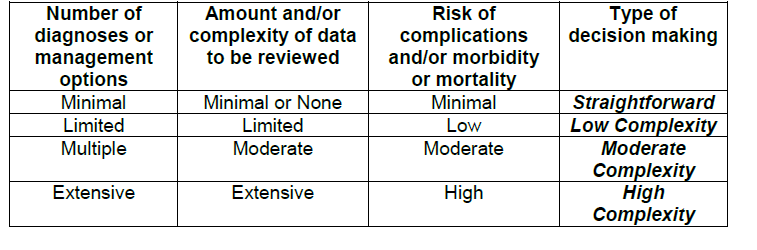
DOCUMENTATION OF THE COMPLEXITY OF MEDICAL DECISION MAKING


The levels of E/M services recognize four types of medical decision making (straightforward, low complexity, moderate complexity, and high complexity). Medical decision making refers to the complexity of establishing a diagnosis and/or selecting a management option as measured by:

the number of possible diagnoses and/or the number of management options that must be considered;

the amount and/or complexity of medical records, diagnostic tests, and/or other information that must be obtained, reviewed, and analyzed; and

the risk of significant complications, morbidity, and/or mortality, as well as comorbidities associated with the patient's presenting problem(s), the diagnostic procedure(s) and/or the possible management options.

The chart below shows the progression of the elements required for each level of medical decision making. To qualify for a given type of decision making, two of the three elements in the table must be either met or exceeded.


Sunday, July 3, 2016

How to Document examination in Medical record

DOCUMENTATION OF EXAMINATION

The levels of E/M services are based on four types of examination that are defined as follows:

Problem Focused -- a limited examination of the affected body area or organ system.

Expanded Problem Focused -- a limited examination of the affected body area or organ system and other symptomatic or related organ system(s).

Detailed -- an extended examination of the affected body area(s) and other symptomatic or related organ system(s).

Comprehensive -- a general multi-system examination or complete examination of a single organ system.


For purposes of examination, the following body areas are recognized:

Head, including the face

Neck

Chest, including breasts and axillae

Abdomen

Genitalia, groin, buttocks

Back, including spine

Each extremity


For purposes of examination, the following organ systems are recognized:

Constitutional (e.g., vital signs, general appearance)

Eyes

Ears, nose, mouth, and throat

Cardiovascular

Respiratory

Gastrointestinal

Genitourinary

Musculoskeletal

Skin

Neurologic

Psychiatric

Hematologic/lymphatic/immunologic


The extent of examinations performed and documented is dependent upon clinical judgment and the nature of the presenting problem(s). They range from limited examinations of single body areas to general multi-system or complete single organ system examinations.

DG: Specific abnormal and relevant negative findings of the examination of the affected or symptomatic body area(s) or organ system(s) should be documented. A notation of "abnormal” without elaboration is insufficient.

DG: Abnormal or unexpected findings of the examination of the unaffected or asymptomatic body area(s) or organ system(s) should be described.

DG: A brief statement or notation indicating "negative" or "normal" is sufficient to document normal findings related to unaffected area(s) or asymptomatic organ system(s).

DG: The medical record for a general multi-system examination should include findings about 8 or more of the 12 organ systems.

Thursday, June 30, 2016

Documenting Past, Family, Social history in Medical record

PAST, FAMILY, AND/OR SOCIAL HISTORY (PFSH) 

The PFSH consists of a review of three areas:

past history (the patient's past experiences with illnesses, operations, injuries and treatments);

family history (a review of medical events in the patient's family, including diseases which may be hereditary or place the patient at risk); and social history (an age appropriate review of past and current activities).


For the categories of subsequent hospital care, follow-up inpatient consultations and subsequent nursing facility care, CPT requires only an "interval" history. It is not necessary to record information about the PFSH.

A pertinent PFSH is a review of the history area(s) directly related to the problem(s) identified in the HPI.

DG: At least one specific item from any of the three history areas must be documented for a pertinent PFSH.

A complete PFSH is of a review of two or all three of the PFSH history areas, depending on the category of the E/M service. A review of all three history areas is required for services that by their nature include a comprehensive assessment or reassessment of the patient. A review of two of the three history areas is sufficient for other services.

DG: At least one specific item from two of the three history areas must be documented for a complete PFSH for the following categories of E/M services:

office or other outpatient services, established patient; emergency department;

subsequent nursing facility care; domiciliary care, established patient; and home care, established patient.


DG: At least one specific item from each of the three history areas must be documented for a complete PFSH for the following categories of E/M services: office or other outpatient services, new patient; hospital observation services; hospital inpatient services, initial care; consultations; comprehensive nursing facility assessments; domiciliary care, new patient; and homecare, new patient.

Tuesday, June 28, 2016

Medical record document - Review of system


REVIEW OF SYSTEMS (ROS)

A ROS is an inventory of body systems obtained through a series of questions seeking to identify signs and/or symptoms which the patient may be experiencing or has experienced.


For purposes of ROS, the following systems are recognized:

Constitutional symptoms (e.g., fever, weight loss)

Eyes

Ears, Nose, Mouth, Throat

Cardiovascular

Respiratory

Gastrointestinal

Genitourinary

Musculoskeletal

Integumentary (skin and/or breast)

Neurological

Psychiatric

Endocrine

Hematologic/Lymphatic

Allergic/Immunologic

A problem pertinent ROS inquires about the system directly related to the problem(s) identified in the HPI.

DG: The patient's positive responses and pertinent negatives for the system related to the problem should be documented.

An extended ROS inquires about the system directly related to the problem(s) identified in the HPI and a limited number of additional systems.

DG: The patient's positive responses and pertinent negatives for two to nine systems should be documented.


A complete ROS inquires about the system(s) directly related to the problem(s) identified in the HPI plus all additional body systems.

DG: At least ten organ systems must be reviewed. Those systems with positive or pertinent negative responses must be individually documented. For the remaining systems, a notation indicating all other systems are negative is permissible. In the absence of such a notation, at least ten systems must be individually documented.


Saturday, June 25, 2016

Medical record - History of Present illness and chief complaint


CHIEF COMPLAINT (CC)

The CC is a concise statement describing the symptom, problem, condition, diagnosis, physician recommended return, or other factor that is the reason for the encounter.

DG: The medical record should clearly reflect the chief complaint.


HISTORY OF PRESENT ILLNESS (HPI)

The HPI is a chronological description of the development of the patient's present illness from the first sign and/or symptom or from the previous encounter to the present. It includes the following elements:

location;

quality;

severity;

duration;

timing;

context;

modifying factors; and

associated signs and symptoms.


Brief and extended HPIs are distinguished by the amount of detail needed to accurately characterize the clinical problem(s).

A brief HPI consists of one to three elements of the HPI.

DG: The medical record should describe one to three elements of the present illness (HPI).

An extended HPI consists of four or more elements of the HPI.

DG: The medical record should describe four or more elements of the present illness (HPI) or associated comorbidities.

Monday, June 20, 2016

How to Document E & M services

DOCUMENTATION OF E/M SERVICES

This publication provides definitions and documentation guidelines for the three key components of E/M services and for visits which consist predominately of counseling or coordination of care. The three key components--history, examination, and medical
decision making--appear in the descriptors for office and other outpatient services, hospital observation services, hospital inpatient services, consultations, emergency department services, nursing facility services, domiciliary care services, and home services. While some of the text of CPT has been repeated in this publication, the reader should refer to CPT for the complete descriptors for E/M services and instructions for selecting a level of service. Documentation guidelines are identified by the symbol  • DG.

The descriptors for the levels of E/M services recognize seven components which are used in defining the levels of E/M services. These components are:


history;

examination;

medical decision making;

counseling;

coordination of care;

nature of presenting problem; and

time.


The first three of these components (i.e., history, examination and medical decision making) are the key components in selecting the level of E/M services. An exception to this rule is the case of visits which consist predominantly of counseling or coordination
of care; for these services time is the key or controlling factor to qualify for a particular level of E/M service.

For certain groups of patients, the recorded information may vary slightly from that described here. Specifically, the medical records of infants, children, adolescents and pregnant women may have additional or modified information recorded in each history
and examination area.


As an example, newborn records may include under history of the present illness (HPI) the details of mother’s pregnancy and the infant's status at birth; social history will focus on family structure; family history will focus on congenital anomalies and hereditary
disorders in the family. In addition, information on growth and development and/or nutrition will be recorded. Although not specifically defined in these documentation guidelines, these patient group variations on history and examination are appropriate.

Wednesday, June 15, 2016

What is Medical record and why its important


WHAT IS DOCUMENTATION AND WHY IS IT IMPORTANT**

Medical record documentation is required to record pertinent facts, findings, and observations about an individual's health history including past and present illnesses, examinations, tests, treatments, and outcomes. The medical record chronologically documents the care of the patient and is an important element contributing to high quality care. The medical record facilitates:

the ability of the physician and other healthcare professionals to evaluate and plan the patient’s immediate treatment, and to monitor his/her healthcare over time;

communication and continuity of care among physicians and other healthcare professionals involved in the patient's care;

accurate and timely claims review and payment;

appropriate utilization review and quality of care evaluations; and collection of data that may be useful for research and education.

An appropriately documented medical record can reduce many of the "hassles" associated with claims processing and may serve as a legal document to verify the care provided, if necessary.


WHAT DO PAYERS WANT AND WHY**

Because payers have a contractual obligation to enrollees, they may require reasonable documentation that services are consistent with the insurance coverage provided. They may request information to validate:

the site of service;

the medical necessity and appropriateness of the diagnostic and/or therapeutic services provided; and/or

 that services provided have been accurately reported.

Wednesday, May 25, 2016

Notes on the Documentation of History


** The CC, ROS, and PFSH may be listed as separate elements of history or they may be included in the description of the history of the present illness.

** A ROS and/or a PFSH obtained during an earlier encounter does not need to be rerecorded if there is evidence that the physician reviewed and updated the previous information. This may occur when a physician updates his or her own record or in an institutional setting or group practice where many physicians use a common record.


The review and update may be documented by:

• Describing any new ROS and/or PFSH information or noting there has been no change in the information; and

• Noting the date and location of the earlier ROS and/or PFSH.

** The ROS and/or PFSH may be recorded by ancillary staff or on a form completed by the patient. To document that the physician reviewed the information, there must be a notation supplementing or confirming the information recorded by others.

** If the physician is unable to obtain a history from the patient or other source, the record should describe the patient’s condition or other circumstance which precludes obtaining a history.

Wednesday, May 18, 2016

E & M Basic - history of illness


History of Present Illness

HPI is a chronological description of the development of the patient’s present illness from the first sign and/or symptom or from the previous encounter to the present. HPI elements are:

** Location (example: left leg);

** Quality (example: aching, burning, radiating pain);

** Severity (example: 10 on a scale of 1 to 10);

** Duration (example: started three days ago);

** Timing (example: constant or comes and goes);

** Context (example: lifted large object at work);

** Modifying factors (example: better when heat is applied); and

** Associated signs and symptoms (example: numbness in toes).

There are two types of HPIs: brief and extended.

A brief HPI includes documentation of one to three HPI elements.

In the following example, three HPI elements – location, quality, and duration – are documented:

** CC: Patient complains of earache.

** Brief HPI: Dull ache in left ear over the past 24 hours.

An extended HPI:

** 1995 documentation guidelines – Should describe four or more elements of the present HPI or associated comorbidities.

** 1997 documentation guidelines – Should describe at least four elements of the present HPI or the status of at least three chronic or inactive conditions.


In the following example, five HPI elements – location, quality, duration, context, and modifying factors – are documented:

** CC: Patient complains of earache.

** Extended HPI: Patient complains of dull ache in left ear over the past 24 hours.

Patient states he went swimming two days ago. Symptoms somewhat relieved by warm compress and ibuprofen.

Sunday, May 15, 2016

Review of Histrory and Chief Complaint during E & M service


LEVEL OF EVALUATION AND MANAGEMENT SERVICE PERFORMED

The code sets used to bill for E/M services are organized into various categories and levels. In general, the more complex the visit, the higher the level of code the physician or NPP may bill within the appropriate category. In order to bill any code, the services furnished must meet the definition of the code. It is the physician’s or NPP’s responsibility to ensure that the codes selected reflect the services furnished. There are three key components when selecting the appropriate level of E/M service provided: history, examination, and medical decision making. Visits that consist predominately of counseling and/or coordination of care are an exception to this rule. For these visits, time is the key or controlling factor to qualify for a particular level of E/M services.


History

The elements required for each type of history are depicted in the table below. Further discussion of the activities comprising each of these elements is included below the table. To qualify for a given type of history, all four elements indicated in the row must be met. Note that as the type of history becomes more intensive, the elements required to perform that type of history also increase in intensity. For example, a problem focused history requires the documentation of the chief complaint (CC) and a brief history of present illness (HPI) while a detailed history requires the documentation of a CC, anextended HPI, plus an extended review of  systems (ROS), and pertinent past, family, and/or social history (PFSH).


TYPE OF HISTORY    CHIEF COMPLAINT   HISTORY OF PRESENT ILLNESS   REVIEW OF SYSTEMS    PAST, FAMILY,AND/OR SOCIAL HISTORY
                                                                                                                                                                           
Problem Focused        Required        Brief                 N/A                 N/A

Expanded Problem Focused     Required         Brief             Problem    Pertinent         N/A

Detailed        Required           Extended               Extended          Pertinent

Comprehensive      Required            Extended                 Complete        Complete


While documentation of the CC is required for all levels, the extent of information gathered for the remaining elements related to a patient’s history is dependent upon clinical judgment and the nature of the presenting problem.


Chief Complaint

A CC is a concise statement that describes the symptom, problem, condition, diagnosis, or reason for the patient encounter. The CC is usually stated in the patient’s own words. For example, patient complains of upset stomach, aching joints, and fatigue. The medical record should clearly reflect the CC.

Thursday, April 28, 2016

GENERAL PRINCIPLES OF EVALUATION AND MANAGEMENT DOCUMENTATION


“If it isn’t documented, it hasn’t been done” is an adage that is frequently heard in the health care setting.

Clear and concise medical record documentation is critical to providing patients with quality care and is required in order for providers to receive accurate and timely payment for furnished services. Medical records chronologically report the care a patient received and are used to record pertinent facts, findings, and observations about the patient’s health history. Medical record documentation assists physicians and other health care professionals in evaluating and planning the patient’s immediate treatment and monitoring the patient’s health care over time.


Health care payers may require reasonable documentation to ensure that a service is consistent with the patient’s insurance coverage and to validate:

? The site of service;

? The medical necessity and appropriateness of the diagnostic and/or therapeutic services provided; and/or

? That services furnished have been accurately reported. There are general principles of medical record documentation that are applicable to all types of medical and surgical services in all settings. While E/M services vary in several ways, such as the nature and amount of physician work required, the following general  Evaluation and Management Services Guide principles help ensure that medical record documentation for all E/M services is appropriate:

? The medical record should be complete and legible;

? The documentation of each patient encounter should include:

• Reason for the encounter and relevant history, physical examination findings, and prior diagnostic test results;

• Assessment, clinical impression, or diagnosis;

• Medical plan of care; and

• Date and legible identity of the observer.

? If not documented, the rationale for ordering diagnostic and other ancillary services should be easily inferred;

? Past and present diagnoses should be accessible to the treating and/or consulting physician;

? Appropriate health risk factors should be identified;

? The patient’s progress, response to and changes in treatment, and revision of diagnosis should be documented; and

? The diagnosis and treatment codes reported on the health insurance claim form or billing statement should be supported by the documentation in the medical record. In order to maintain an accurate medical record, services should be documented during the encounter or as soon as practicable after the encounter.

Popular Posts